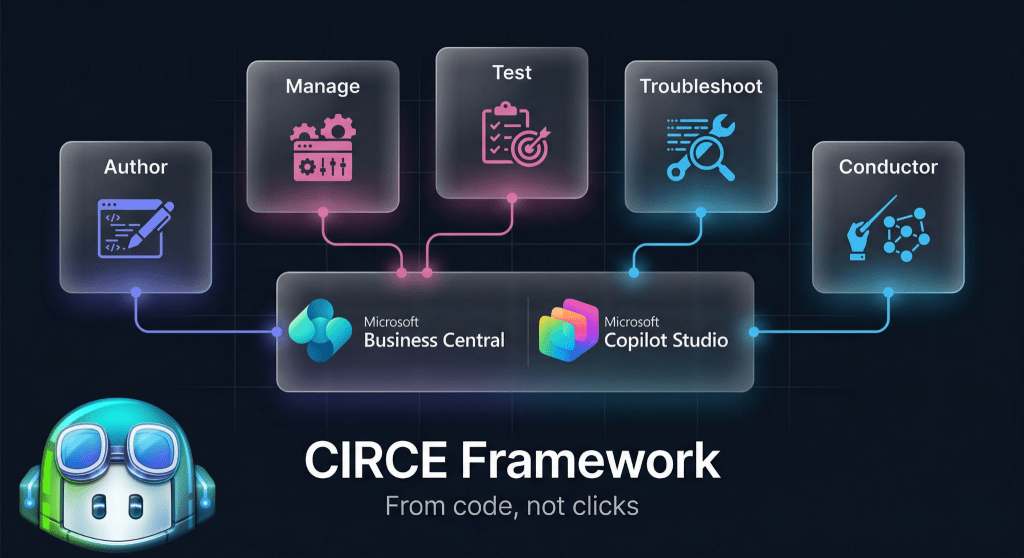
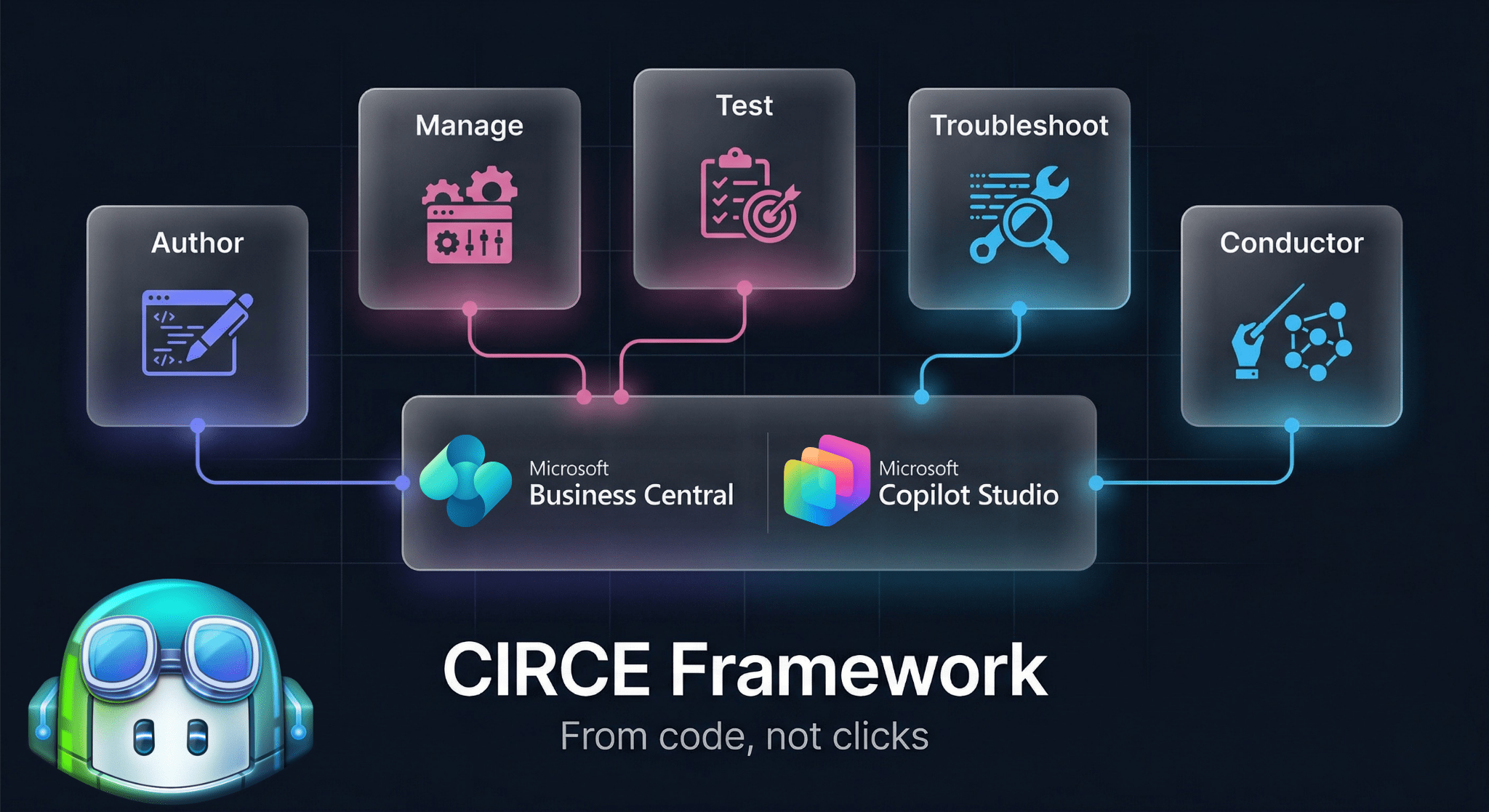
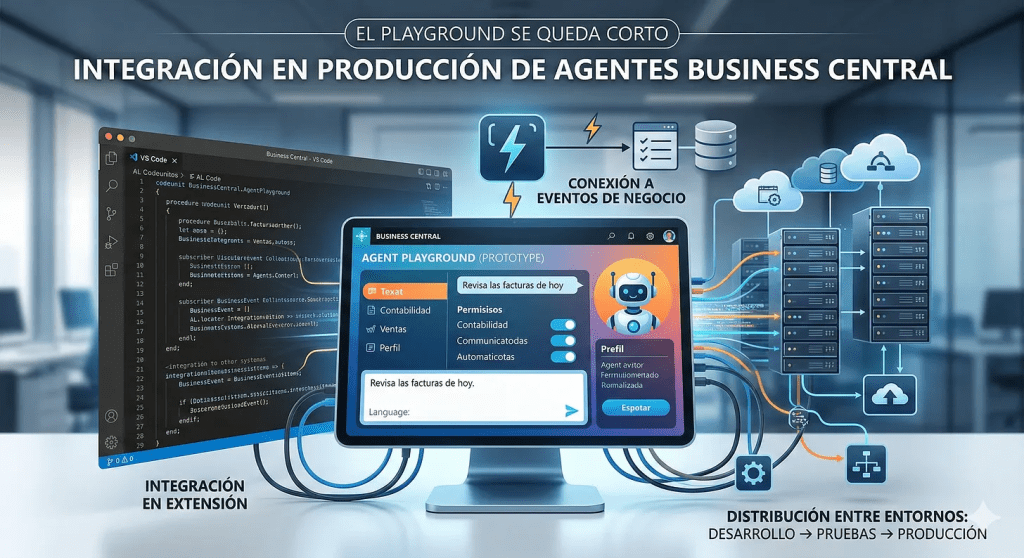
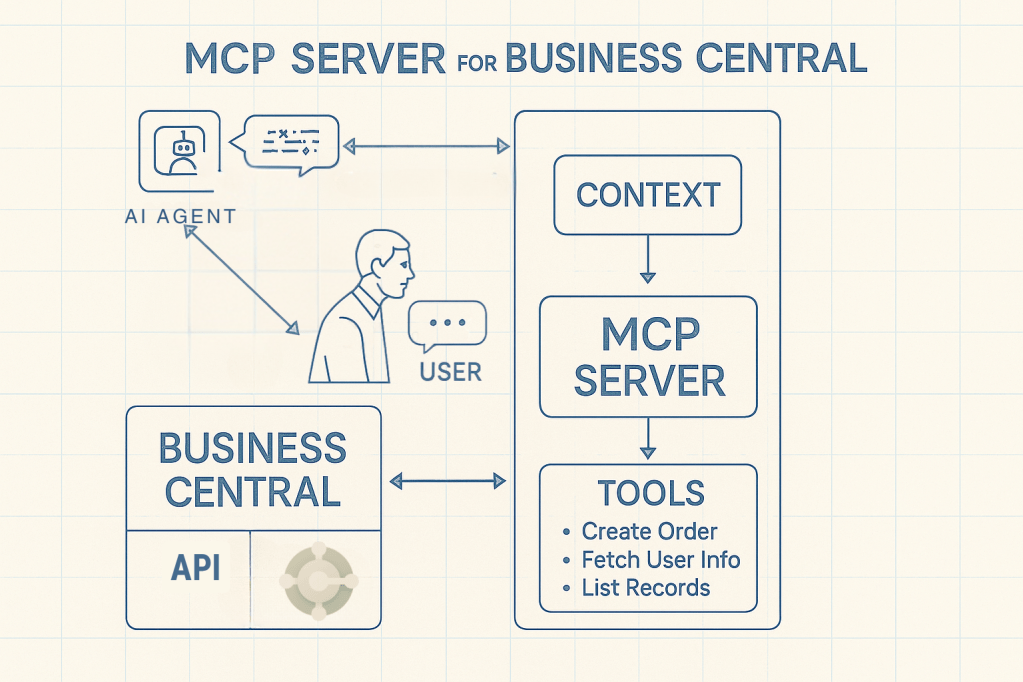
Microsoft is betting heavily on agents in Copilot Studio. The Business Central MCP Server (available since BC 27) enables conversational agents to connect directly with business data: customers, orders, invoices, receivables. But moving from a quick demo to a production agent requires something the platform does not yet provide out of the box: governance, traceability, automated validation, and a reproducible development workflow.
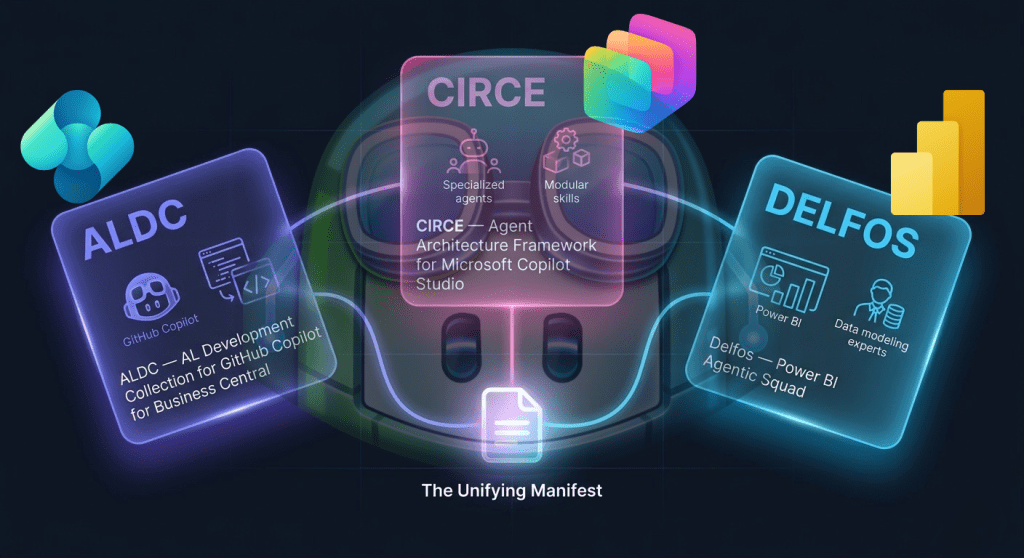
CIRCE fills that gap. It is an open-source framework that extends Skills for Copilot Studio — the plugin created by Giorgio Ughini and the Power CAT team at Microsoft — with enterprise governance layers and a domain-specific extension pack for Business Central.
What CIRCE is and what it builds on
Copilot Studio lets you build conversational agents with YAML. The base plugin by Giorgio Ughini and the Power CAT team provides the foundation that makes YAML-first development possible: schema validation, five Node.js CLI scripts bundled with esbuild, reusable templates for topics and actions, and automated testing with point-test and batch suites. It is solid, open-source work that deserves recognition.
CIRCE builds on that foundation by adding what a professional team needs to manage agents at scale. Cross-session memory that persists project state in a versionable circe-memory.md file alongside the agent. Lightweight decision records that document every design choice with context, alternatives, and consequences. HITL (Human-in-the-Loop) gates that block push if schema validation fails and present a summary with diff and pending decision records before requesting explicit approval. Skills evidencing where every operation declares which skills it loaded, which templates it used, and which patterns it applied. And a Conductor agent that orchestrates multi-step workflows by delegating to the right specialist agent at each phase.
The result is 5 specialized agents (Author, Manage, Test, Troubleshoot, Conductor) and over 33 modular skills covering everything from topic creation to deployment and testing of published agents.
The BC Extension Pack: Business Central as a first-class citizen
The component that sets CIRCE apart is the BC Extension Pack — five domain skills designed specifically for agents that integrate with Dynamics 365 Business Central via MCP Server.
bc-mcp-setup walks through the complete configuration: enabling MCP Server in Feature Management, configuring API pages with granular permissions, choosing between Dynamic Tool Mode (runtime discovery, no tool limit) and Explicit Tool Mode (precise control, predictable performance), connecting in Copilot Studio, and validating with a test query. Includes troubleshooting tables for the most common errors.
bc-instructions-patterns provides seven composable instruction blocks: BC data context, amount and date formatting, protection rules, traceability, and domain-specific blocks for collections, sales, and support. They combine based on agent type with a clear composition table. Protection rules are non-negotiable: never send external communications if there is an active dispute, a material ledger-aging inconsistency above 5% or 1,000€, or a blocked customer in BC.
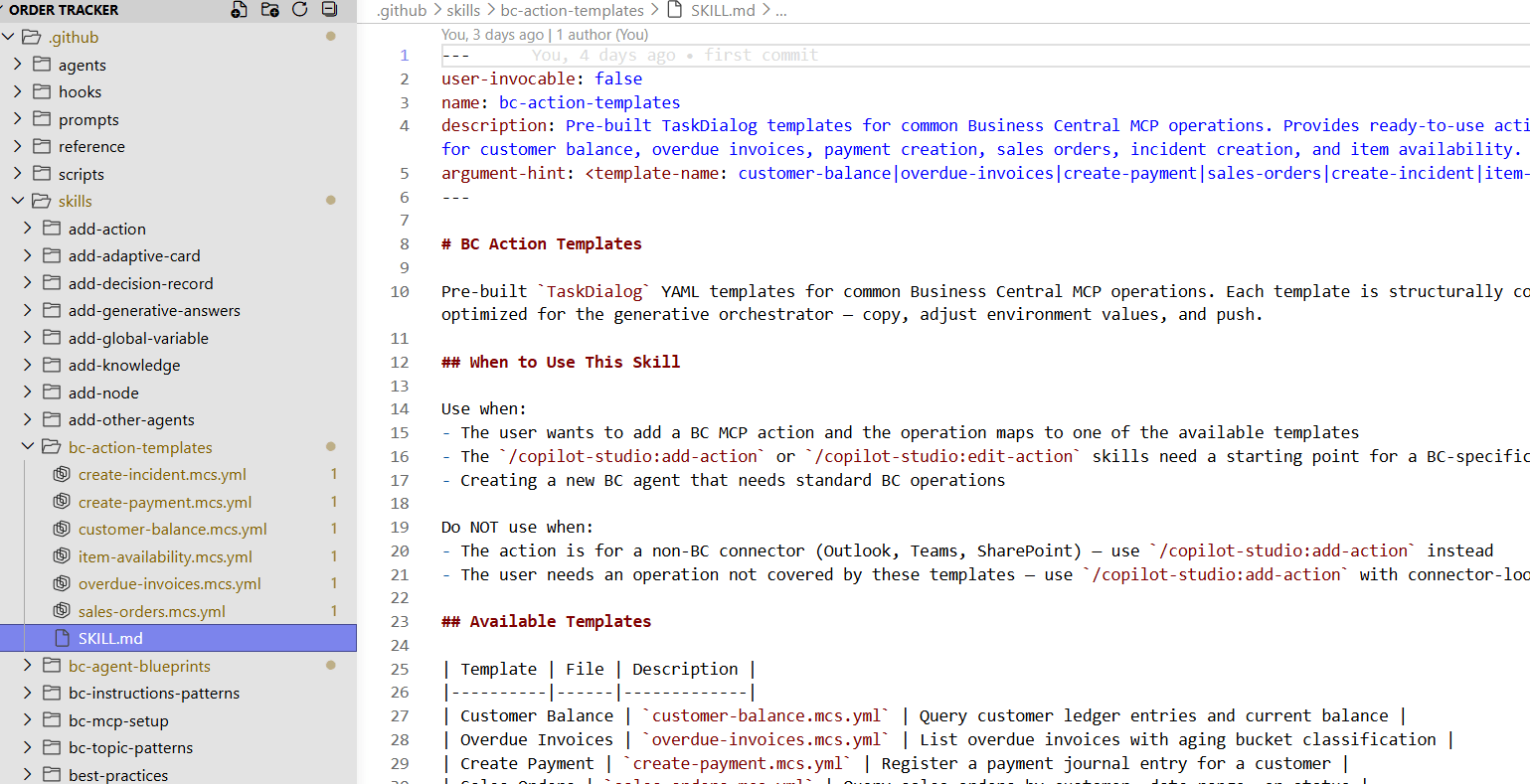
bc-action-templates offers six ready-to-use TaskDialog templates: balance queries, overdue invoices, payment creation, sales orders, incident creation, and item availability. Each template includes a modelDescription optimized for generative orchestrator routing.
bc-topic-patterns contains reusable patterns with a decision matrix: when to let the generative orchestrator handle the scenario with instructions and MCP alone, and when to create a custom topic with Adaptive Cards and deterministic logic. The general rule is that if you need an Adaptive Card, a deterministic business rule, or conditional branching, you create a topic. Otherwise, the orchestrator is sufficient.
And bc-agent-blueprints integrates everything above into complete specifications for three typical scenarios: collections (with dispute protection and aging-based escalation), sales (with credit verification and availability checks), and customer support (with incident creation and human escalation triggers).
The real development workflow
The CIRCE development workflow reflects how real projects work. The agent is first created as an empty shell in Copilot Studio — just the name, nothing else. This gives it an identity on the platform (schema name, agent ID, environment URL). It is cloned to the local workspace with the Manage agent. Built with the Author agent using skills and templates validated against the schema. Passed through a pre-push review gate that validates all YAML, runs a coverage report, and presents a summary with associated decision records. Pushed as a draft. Manually published in the Copilot Studio UI. And tested with the Test agent sending utterances against the published agent.
The Conductor orchestrates this entire flow with HITL gates between each step. If validation fails, push is blocked. Nothing executes without explicit user approval.
Try it: Order Tracker in 30 minutes
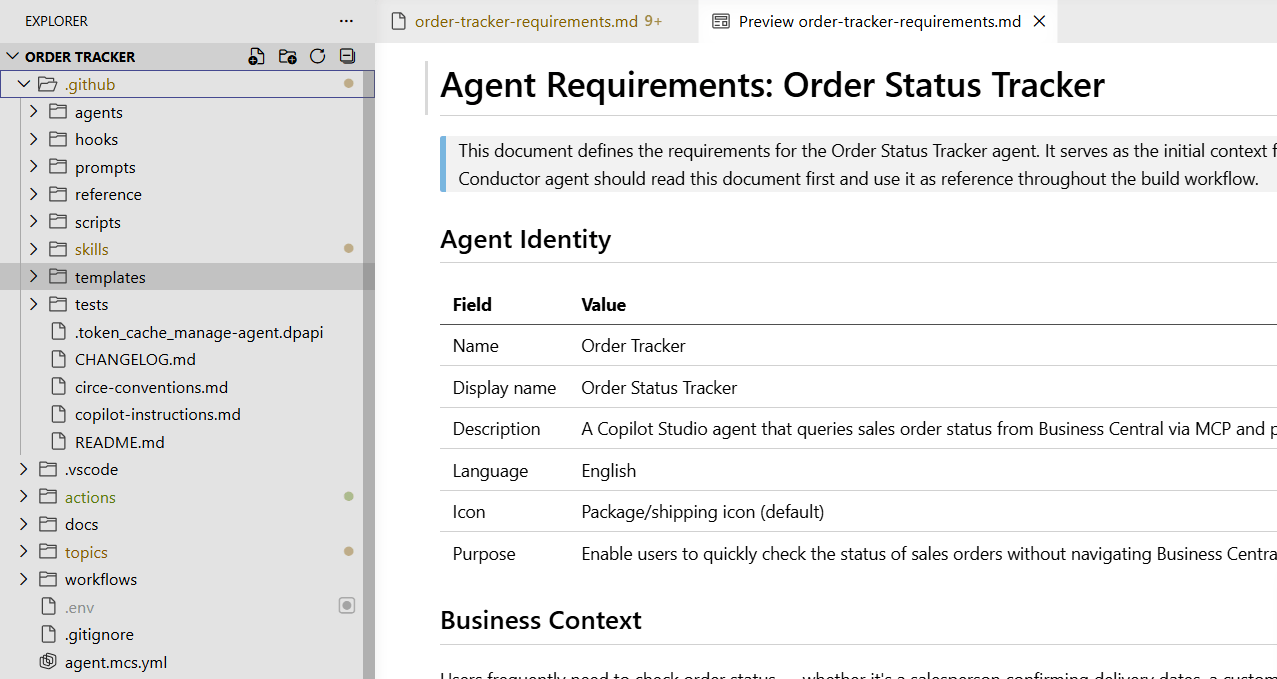
The repository includes a complete quickstart to validate the framework end to end. It is called Order Tracker: an agent that queries sales orders in CRONUS via MCP and displays results in an Adaptive Card with color-coded statuses. Three phases, three prompts, thirty minutes. It covers clone, MCP setup, action templates, topic patterns, Adaptive Cards, memory, decision records, pre-push review, push, and point-test.
If Order Tracker works, the natural next step is to add overdue balance queries and payment reminder emails — turning the agent into a mini Collections Agent that validates the instruction patterns with protection rules and the Outlook MCP integration.
Credits
CIRCE would not exist without the work of Giorgio Ughini and the Power CAT team at Microsoft on Skills for Copilot Studio. They built the foundation: the schema validation engine, the CLI scripts, the skill architecture, and the testing infrastructure. CIRCE extends their work; it does not replace it.
📚 References
- Skills for Copilot Studio — Giorgio Ughini & Microsoft Power CAT team
- Configure Business Central MCP Server
- BC Agent SDK Overview
- Microsoft Copilot Studio Documentation
🟦 The distance between an agent demo and a production agent is not just technical — it is about process, governance, and traceability. CIRCE is an attempt to close that gap for the Business Central ecosystem, building on the shoulders of those who already did the hard work on the base layer.




































 Tech Sphere Dynamics
Deja un comentario