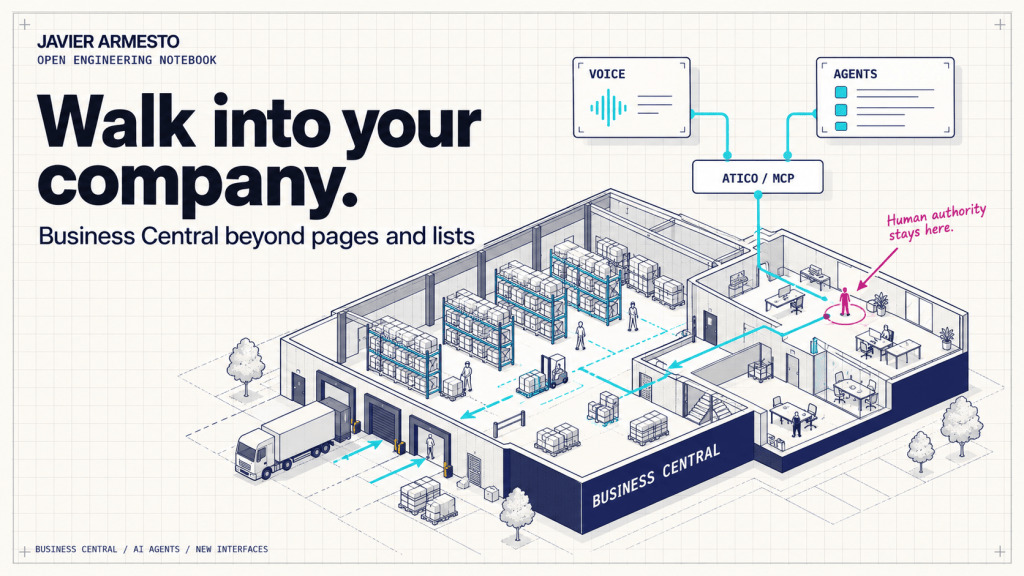
For a few weeks I have been working on an experiment that started as a game and ended up telling me quite a lot about how we are going to work with ERP systems. I called it Atico: a 3D warehouse, styled like a strategy game, connected live to Business Central. Here is the video, and below I explain what sits behind it.
A warehouse you can walk through
The first thing you see is a campus: the main building, the receiving, storage and shipping zones, trucks coming and going, and an inventory panel. Underneath is Business Central, in this case the CRONUS USA demo company in a sandbox. The inventory, the open amount and the sales orders shown in the panels come from there.
Then you can step inside. There is a floor plan with the aisles, every product in its bin, and one office per functional area: Sales, Finance, Purchasing, Manufacturing and Service. Each office summarises what is happening in its area.
What I wanted to test was whether an ERP is easier to understand when you can walk through it than when you navigate it through pages and lists, especially for people who do not live inside Business Central every day.
The agentic chain, piece by piece
Behind the warehouse there is a chain of six pieces, each with a specific job. Sofía understands what is being asked. Cafelito is the agent that takes orders by voice. ATICO is the MCP connector that talks to Business Central. Business Central records. The 3D warehouse executes and makes it visible. Finance measures the outcome.
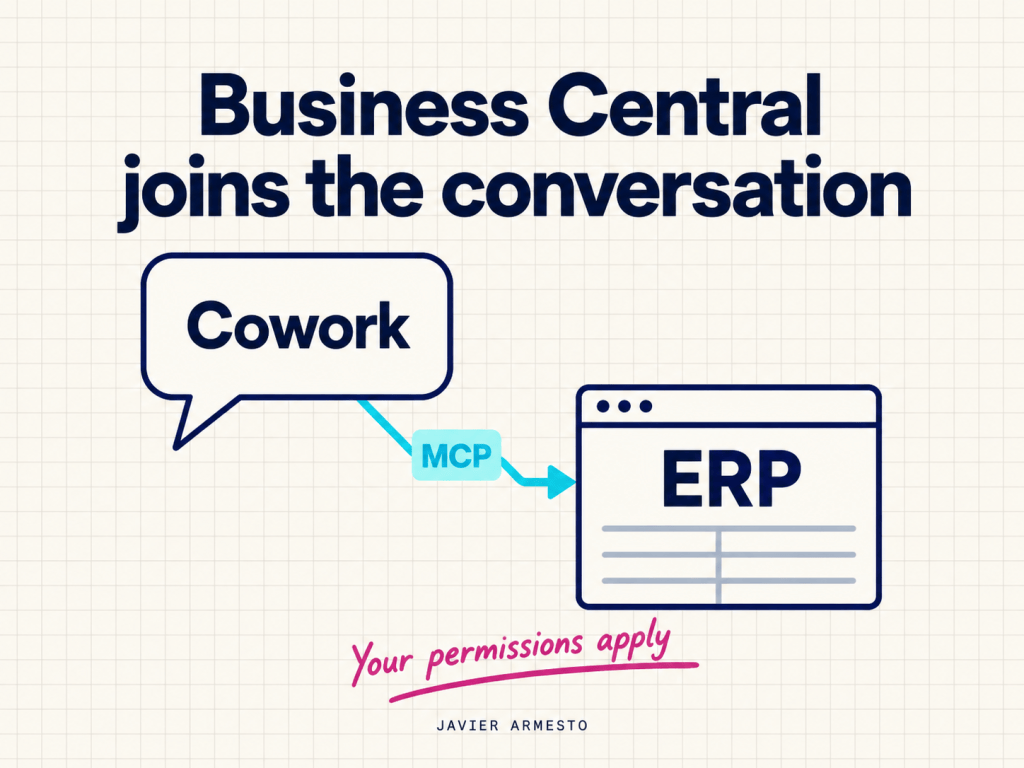
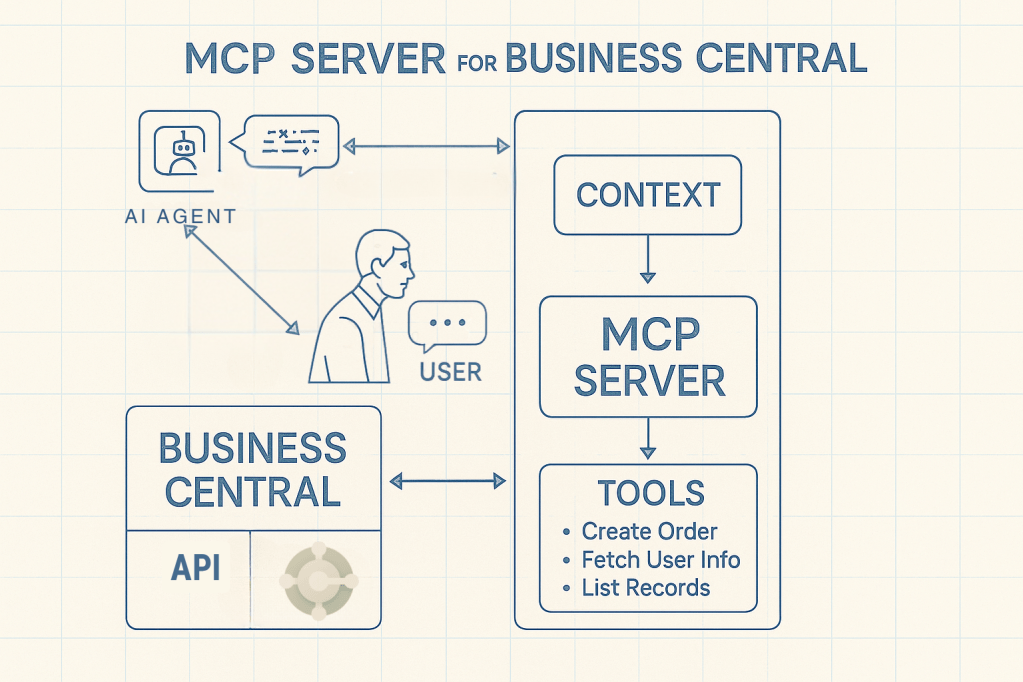
ATICO holds it all together. It is an MCP (Model Context Protocol) server that makes Business Central available to any agent that speaks the protocol. That is what lets Cafelito, Sofía and the warehouse itself work on the same ERP without a custom integration for each one.
Three moments from the video
The first one is Cafelito. A customer, Adatum Corporation, orders by voice four bags of Kenyan coffee and two of Colombian decaf. The agent understands the request, prepares the lines, and sales order S-ORD101202 shows up in Business Central for 493 dollars. A few seconds later the warehouse starts picking it while a truck arrives.
The second one is quality control. A robot spots a damaged box, removes it, and a negative adjustment is posted to the item journal. Nobody opened a card or filled in a journal by hand.
The third one is the walkthrough. Around the one-minute mark the scene fades and we enter the building: floor plan, aisles and offices. Here the question changes from «where is that page?» to «what is happening in this area?».
My take: what matters sits beneath the warehouse
The 3D warehouse is the eye-catching part, and I admit I had fun building it. But the game-like approach is the least important thing here. Tomorrow the same scene could be a panel in Teams, a conversation with an agent or a screen at the loading dock, and what sits behind it would work exactly the same.
What really changes things is Business Central stepping outside its native interface. For years, working with the ERP has meant going into its pages, lists and cards, and if you wanted the data somewhere else you needed a custom integration for every case.
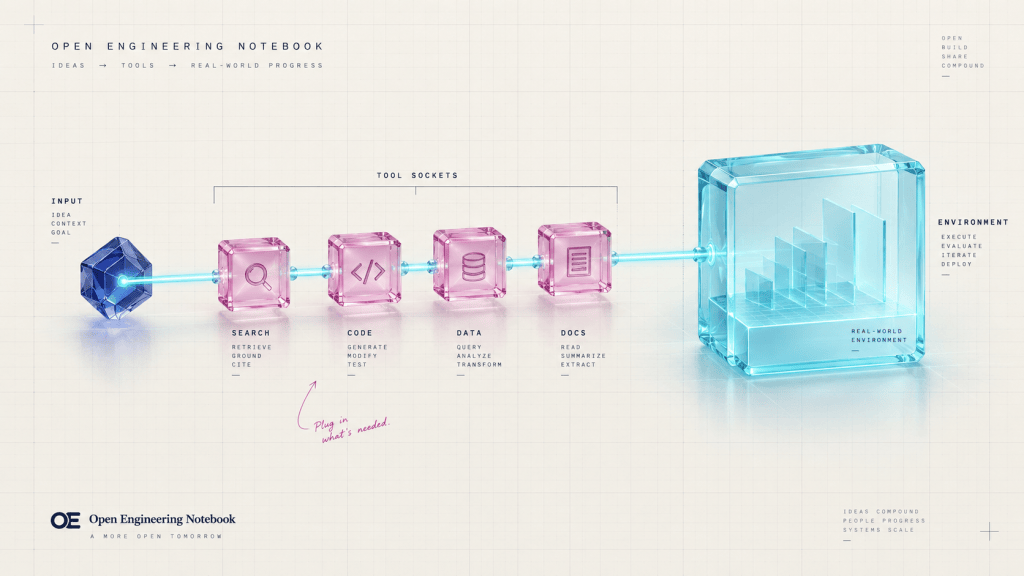
That is what ATICO makes possible. By exposing Business Central through MCP, an open standard protocol, any client that speaks it can read from and write to the ERP: a voice agent, an assistant such as Claude or Copilot Studio, or a 3D warehouse. The interface becomes a per-case decision, and Business Central remains the source of truth.
So the discussion I find interesting is what we let agents do on top of the ERP, with which permissions, and who reviews what they record. Which screen we put on top comes after that.
Atico is just one way of showing it and seeing which questions come up.
References
Full video on YouTube: https://youtu.be/-NhK9OBDkvI
Model Context Protocol, specification and documentation: https://modelcontextprotocol.io
Business Central documentation on Microsoft Learn: https://learn.microsoft.com/dynamics365/business-central/
Closing
If you would like to see it live, or think through how something like this could fit your company, get in touch and let’s talk.























Deja una respuesta