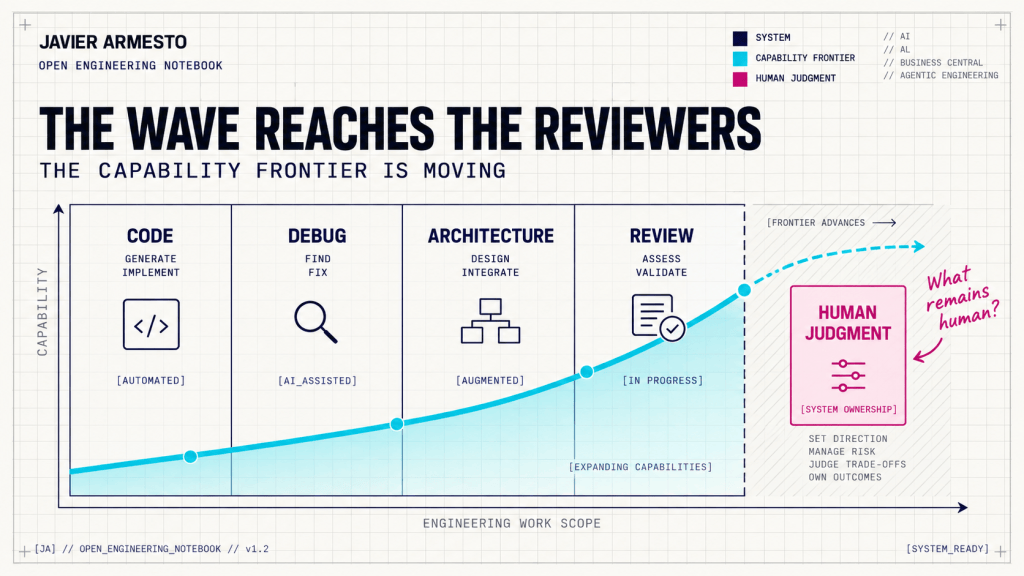
When I read this in my X feed, my first thought was that we would be hearing news about an evolution of Claude Code very soon. After reading the replies and thinking about it, I believe what he really wanted to do was stir the hornet’s nest and touch a nerve at the next level.
What do I mean by touching a nerve at the next level? In short, the conversation evolves from «programmers are no longer going to write lines of code because they will be reviewing, contributing architecture, and so on» — and by programmers I mean senior programmers, since juniors were already «no longer necessary» because coding agents already do that work. Please put all of this between quotation marks, of course.
Now the creator of Claude Code steers the conversation towards agent-generated code being on its way to having no bugs and needing no review. And that points to an obvious question: are the senior programmers who review code the next ones on the substitution list?
How does that land?
Cherny’s roadmap
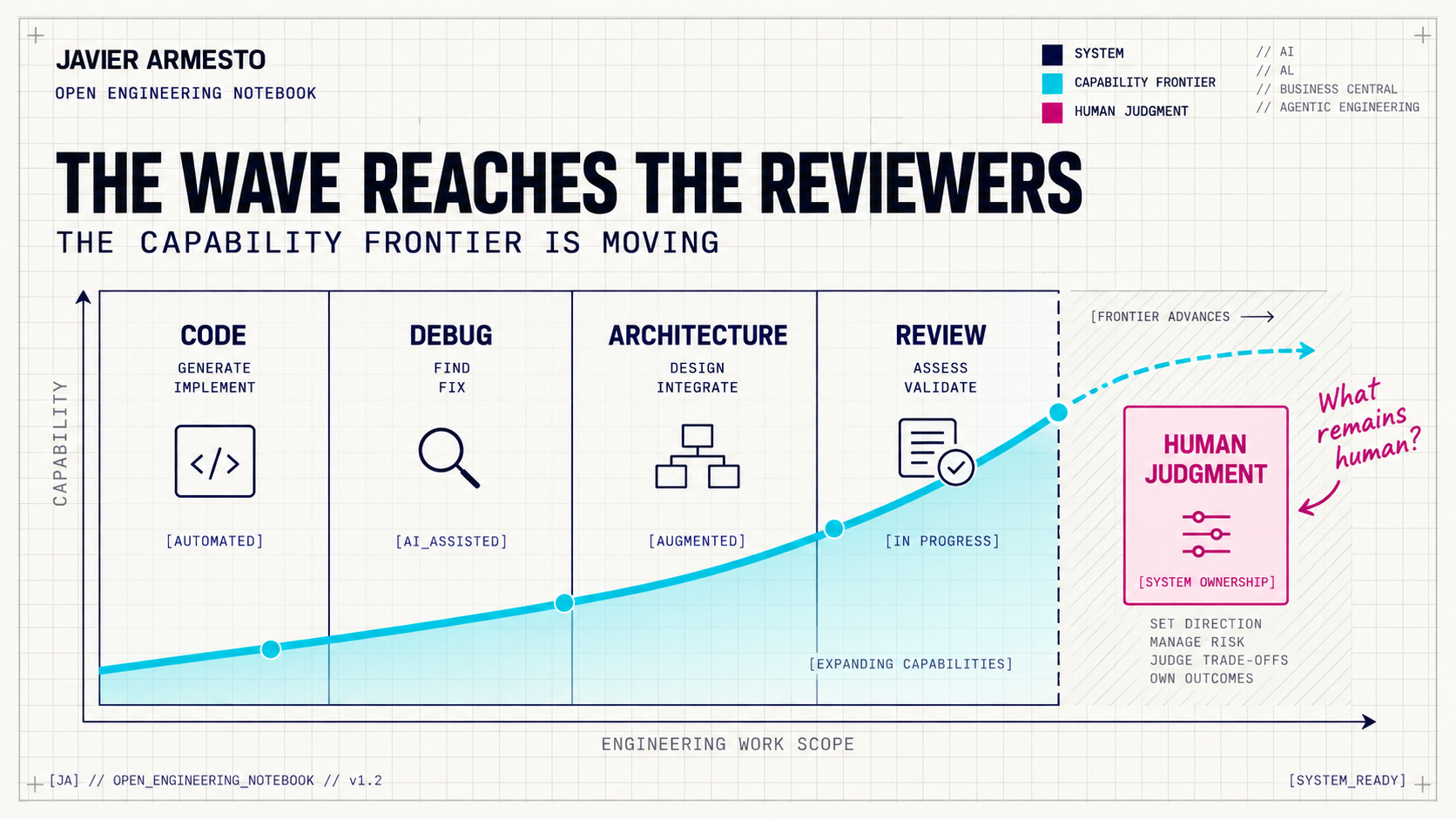
Well, scratching a bit deeper and stepping away from the sensationalist angle (although where there’s smoke… or better said, the wave is starting to form…), the debate — and what really caught my interest — was about which areas coding agents may end up covering.
According to Cherny: «In the future, models will generate bug-free code, with great architecture and UI, etc.» But he adds: «getting there requires time, effort and research.» What is undeniable is that frontier models are increasingly capable and deliver better code. Yes, still with mistakes, but they keep improving — and not only at churning out lines of code, but also at architecture and, of course, UI.
As Cherny sees it, the roadmap (past to future) looks like this:
- Models are able to program better than us.
- Models are able to do engineering work adjacent to programming better than us: debugging, profiling, optimization, bug fixing, system design, abstraction design, UI design, idea generation, etc.
- Models are able to do most things that can be done on a computer better than most people.
Cherny may be talking his own book here, but his privileged position in terms of capabilities and resources is undeniable. Point 1 is already achieved. Point 2, not entirely yet, but largely so — hence the part about bugs, fixes and so on. And for point 3 he sees early findings, still premature.
Time for self-reflection?
At this point, do you think it is time for some self-reflection? He is already doing it:
«One way to understand the evolution of models is to think of them as moving through the distribution of human capabilities. I consider myself an average programmer and, being honest, Claude has already surpassed me at quite a few tasks. That does not mean it has surpassed every developer. Not yet. But the frontier keeps advancing, and it keeps leaving more professionals on the other side.»
Imagine that. If a profile like Cherny says that about himself, where does that leave the rest of us? Where does it leave you?
And now I will poke the wound, since the Business Central world is fertile ground for egos, deification and so on… As a programmer, how do you rate yourself against that statement? Anything short of considering yourself high or very high level (that is, «I am indispensable», something very common in the BC world) means accepting that coding agents have already surpassed you.
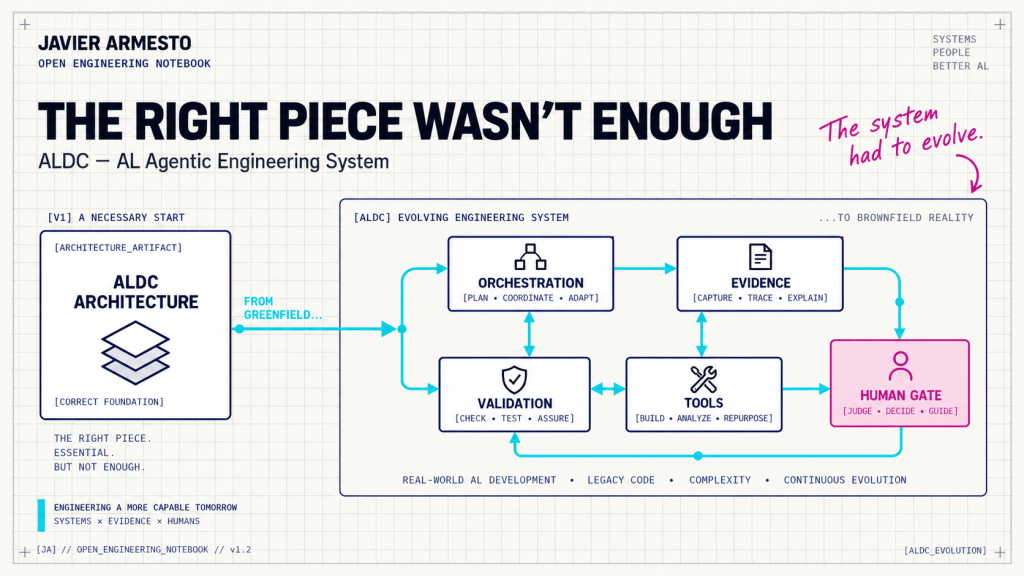
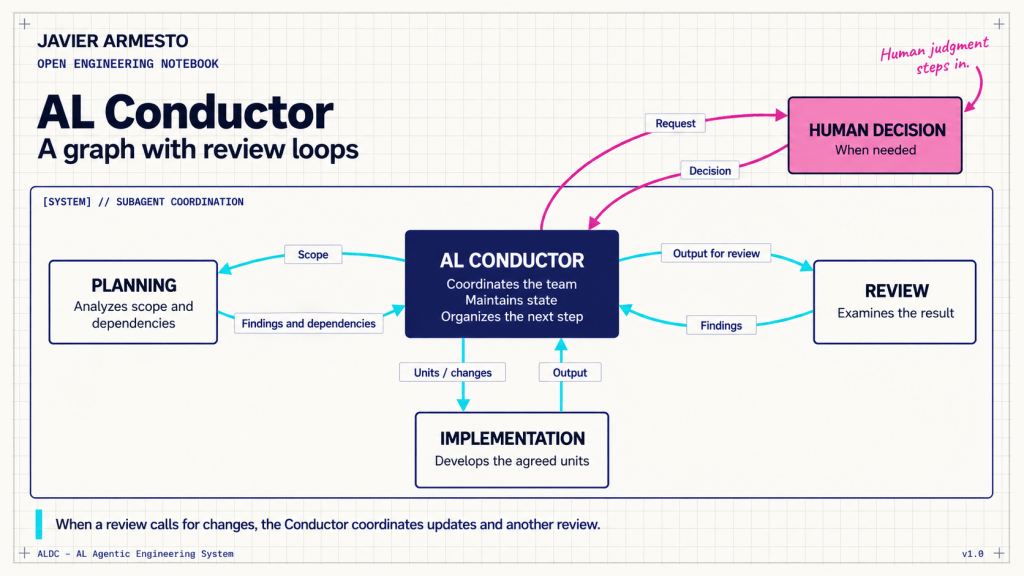
I have never considered myself a programmer — or at least it has never been my focus — and I have certainly never considered myself an expert. But since the wave arrived, I have been doing programming-related work more and more; ALDC is a product of that. And I increasingly feel the frontier getting closer and closer to me.
Tactical vs strategic: the two camps
Given all this (I will come back to the BC world later), what has happened, or what is happening? Well, an expected reaction. Those who did accept that bulk code written by humans is no longer necessary and has practically disappeared — the same people who, at the beginning, said it would never happen because there were too many errors, that it was worse than a junior programmer, and so on… It happened, as we all know. As I was saying, those same people now step aside and say: agreed on point 1 (models are able to program better than us), but absolutely not on point 2.
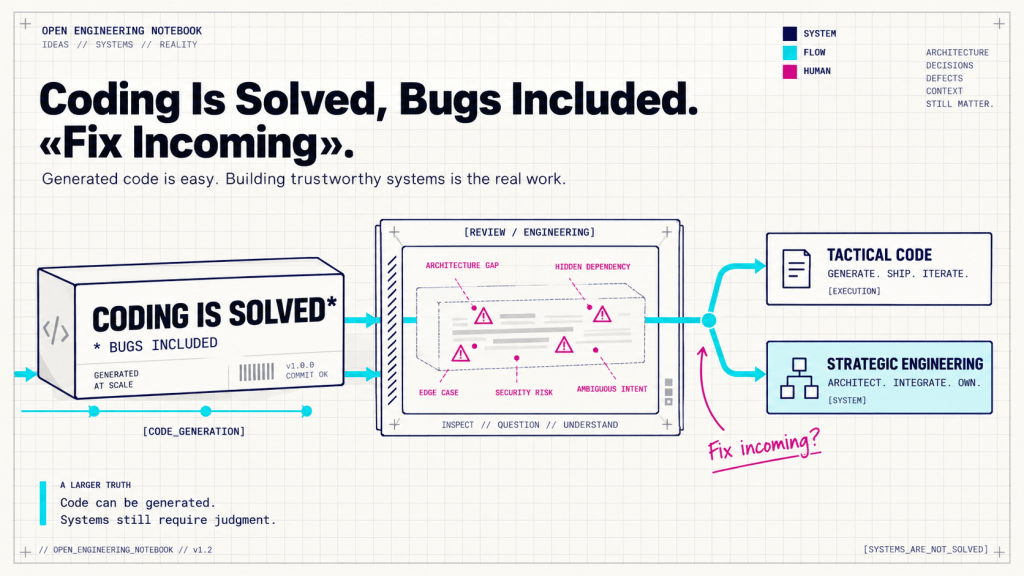
The debate is served, colleagues — and I think it is a necessary one. Once again we have two camps (a recurring pattern with everything related to AI). In the opposite camp, or at least in disagreement with part of Cherny’s claims, are those who look at programming by distinguishing between tactical and strategic programming.
Tactical programming is already in the hands of agents: the day-to-day coding, assigned through tasks or following a plan, supervised by humans. Strategic programming is where agents still do not reach on their own, where human judgment is still necessary — I encourage you to read my previous article. This strategic programming requires architecture, a medium and long-term view, codebase health and hygiene, and so on.
Here, according to this camp, there is no evidence. According to Cherny there is — at least with Fable/Opus 5, he believes there is.
And in the Business Central world?
To wrap up — and this deserves an article of its own (the next one) — what does all this mean in the AL and Business Central world?
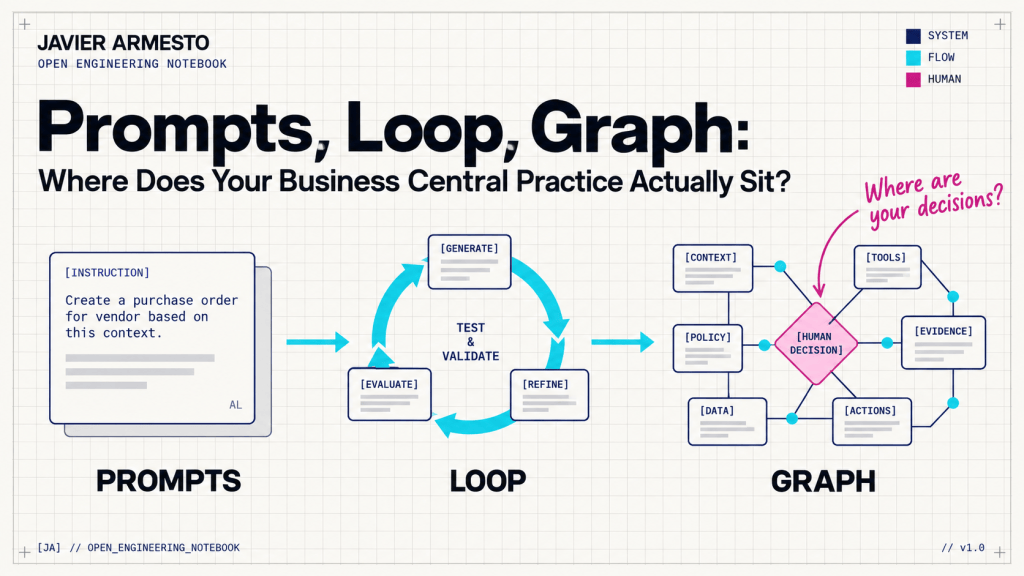
For me, what it means is that the reflection is no longer about whether you write code or not. You need to answer these questions instead: what kind of programming profile do you have (tactical or strategic)? How do you perceive yourself? What did you think less than a year ago about AL programming with agents? Where are you now? You don’t know? Prompts?… loop?… graph?
In the next article, I will take my own experience with ALDC as a starting point — its evolution over just 8 months (12 for me) — to bring everything discussed here into the Business Central world.




























Deja un comentario