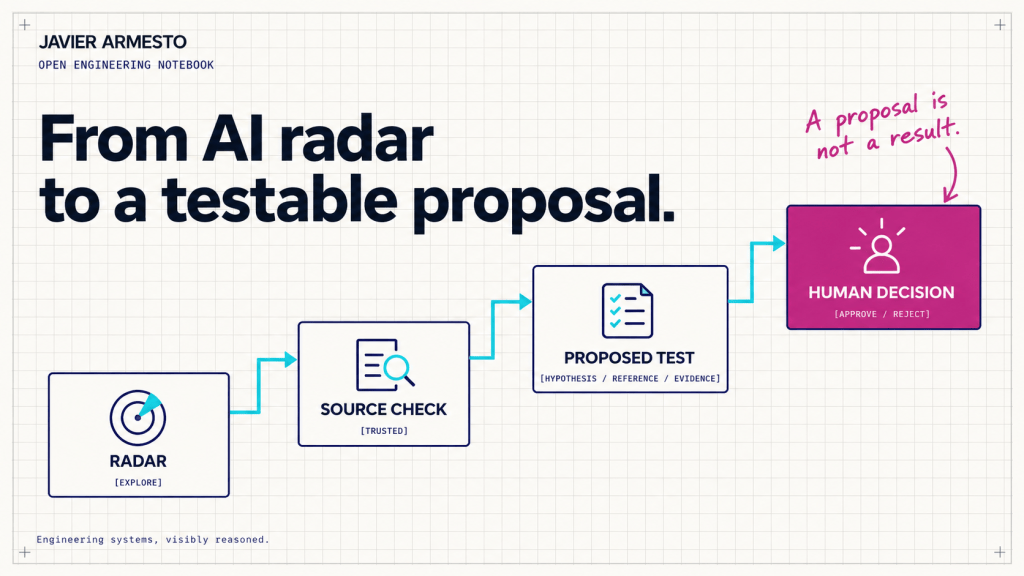
A useful AI radar should help a team choose its next step. A list of announcements is a starting point, but it does not explain which business problem deserves a test or what evidence would justify further work.
This is the idea behind the interactive interface I am preparing for Huelva Summit. Its question is simple: “What should we test next?” The proposed process connects four stages: radar, source checking, opportunity and human decision.
Separate the fact from the hypothesis
The recent Copilot Studio radar includes Extract node. Microsoft documents configurable extraction of values and tables from documents. Access in our own environment still needs checking. [1]
The business hypothesis is that preparing invoice data could reduce manual transcription. That is a hypothesis about a process, not a documented product result. Review effort may remove the expected benefit.
Keeping these statements separate prevents the interface from turning a feature description into a productivity claim.
Define a small experiment
My proposed first test uses five fictional invoices with different layouts. This sample is intended to reveal problems, not to estimate general productivity.
The team would agree on the required fields: invoice number, date, taxable amount, tax and total. A human reference would be prepared before running the extraction. Each output field would then be compared with that reference.
The record should include missing values, incorrect values, manual corrections and review time. Observed credit consumption should also be recorded if the test is approved and run. There should be no ERP write operation in this first experiment.
Check the execution context
Microsoft distinguishes the GitHub Copilot harness in Copilot Studio from the GitHub Copilot service. The name alone does not establish a subscription requirement. [3]
For that Copilot Studio harness, usage-based billing includes building and testing. The team should check environment conditions and agree on a consumption limit before running the experiment. [2]
Make the decision visible
The interface should show the documented fact, the untested hypothesis, the source, the proposed next step and the human decision required. “Investigate”, “Test” and “Communicate” represent different preparation activities.
An agent can prepare requirements, test documents and a draft explanation. A person chooses the process, approves the test and decides whether its results support further work.
This interface is a planning aid. Its controls do not run document extraction or approve business operations. A useful acceptance check for the interface is whether a reader can distinguish a proposed experiment from a completed one without opening a separate explanation.
That distinction makes the radar actionable while preserving uncertainty. The next step can be small and specific, even when the final value is still unknown.
Sources: [1] Extract node. [2] Usage-based billing. [3] Harnesses in Copilot Studio.























Deja una respuesta